Saturday, November 19, 2011

Vaccines save lives

Sure, you knew that the world eradicated smallpox in 1979, but did you know polio has also been eliminated 99% worldwide?


Bill Gates narrates a short talk about vaccines and why they're so important - and also so easy, so cheap, and so obvious as a means to save lives. The talk was animated in a fun way, check it out (it's only 3 minutes long):


The Bill & Melinda Gates Foundation also has a neat interactive infographic on its site, illustrating the fight against malaria, as well. You can see all the progress the world has made, and how much more we still need to do to ensure a healthy life for everyone.

Monday, November 14, 2011

Why the Titanic is a bad metaphor

Someone used the phrase "could crash and burn like the Titanic" when talking about the potential dangers of a project recently, and rather than be perturbed over the use of "burn" rather than, say, "sink", I got annoyed at another invocation of the huge ship. The Titanic is used so often as a metaphor for man's hubris that the satirical newspaper The Onion fake-back-dated an article to 1912 that says, "World's Largest Metaphor Hits Ice-Berg: Representation of Man's Hubris Sinks in North Atlantic."


On the surface, it makes sense: vain, overzealous shipbuilders and titans of industry boasted that the Titanic couldn't be sunk, even going so far as to not include very many lifeboats, and then it sank anyway. Clearly, mankind should be more humble. We should learn a lesson from the disaster, and not overreach. Specifically, we should reign in science and technology so they never get too out of hand.

Sure, on the surface it makes sense. But lurking below the surface is the much-larger realization that this is an incorrect lesson to draw from the events of 1912. After all, what did we do after the Titanic sunk? Did we learn our lesson and stop making all boats? Did we declare the Titanic's 882-feet length the upper limit in boat construction and vow never to try to approach that size again?

No. Today, the world's largest ship is almost twice the length of the Titanic. Lots of ships are larger than the Titanic - oil tankers, container ships, aircraft carriers. There are even a few that are passenger ships like the Titanic was. They're all doing fine; no icebergs to report. So, we didn't really reign in our hubris at all. Take that, lesson!

But that's not really true - we did learn our lesson. But the lesson was: take what practical information can be learned from our mistakes and apply it to keep pushing forward anyway. I'm sure that boats built after 1912 contained more lifeboats, for example, and maybe routes changed to better avoid icebergs. Perhaps construction was changed in ways to make large boats sturdier.

So this is why this metaphor annoys me. It's a subtle difference in some ways, but the context I've often seen the Titanic metaphor in implies that science should be reigned in, while the real-world lesson learned vindicates science. After all, the whole point of scientific development is to allow mistakes and the constant refinement of knowledge. Science and technological development are less hubristic than other fields of human endeavor, like art, religion or politics. And while the Titanic was a disaster in terms of lives lost, it was also an essential step on the long path of progress that led us to where we are today.

Sunday, November 6, 2011

I bet you haven't thought about water today. Exactly.


We are lucky to live in an era of history when water is not a concern for many of us: we can go about our daily lives without even thinking about it, and just get as much water as we like at any moment. This would have astonished our ancestors.

Charles Fishman, in The Big Thirst, warns that this might change soon, as new shortages force us to value water more (again.) But here are at least two pieces of good news excerpted from that book, one historical and one current:

"One hundred years ago, with the dawn of bacteriology, two things happened. Cities started aggressively separating their freshwater supplies from their sewage disposal, something they had been surprisingly slow to do. (Philadelphia is just one of many cities whose sewage system, 100 years ago, emptied into a river upstream of the city water-supply intakes from the same river.) And water utilities discovered that basic sand filters and chlorination could clean and disinfect water supplies, all but assuring their safety. … Between 1900 and 1940, mortality rates in the united States fell 40 percent. … Clean water [also] cut child mortality in half."

"It is a mistake to imagine that small changes don't matter, or that even big water issues are not manageable. One of the most startling and least well-known examples involves the United States. The U.S. uses less water today than it did in 1980. Not in per capita terms, in absolute terms. U.S. water use peaked in 1980, at 440 billion gallons a day for all purposes. Today, the country uses less than 410 billion gallons a day. That performance is amazing in many ways. Since 1980, the U.S. population has grown by 70 million people. The U.S. GDP has more than doubled in constant dollars: We use less water to create a $13 trillion economy than we needed to create a $6 trillion economy. It has been nothing less than a revolution in water use in the biggest economy in the world, a completely silent revolution. Most of the change has come in water use by power plants and farms. Farmers today use 15 percent less water than they did in 1980, and produce a 70 percent larger harvest."

Guardian article on The Secret Peace


Really great full-length article by Paul Harris in the Guardian/Observer last weekend. It talks about The Secret Peace and a few other related books that have recently just come out, like Steven Pinker's book on declining violence.

There was also a very lively debate in the article's comments section, with a lot of the usual detracting arguments I hear, but also a lot of defenders. The most common argument I often hear about the book is, "How can you say things are perfect when such-and-such is so bad?" Of course, this is a misunderstanding of my thesis; I don't deny the awful things happening in the world today. I only make the claim that it was worse in the past, and keeps improving. It was interesting to read in these comments a clear environmental spin (ie. Who cares what progress we make, since it's all going to be wiped out by global warming.) This is a British paper, and the environment is more of an issue there, so perhaps that's responsible for that trend in the comments. To those people I say: Read the chapter in my book about the environment. Oh, and then read the rest of the book, too.

Check out the full article and the comments here.

Sunday, October 23, 2011

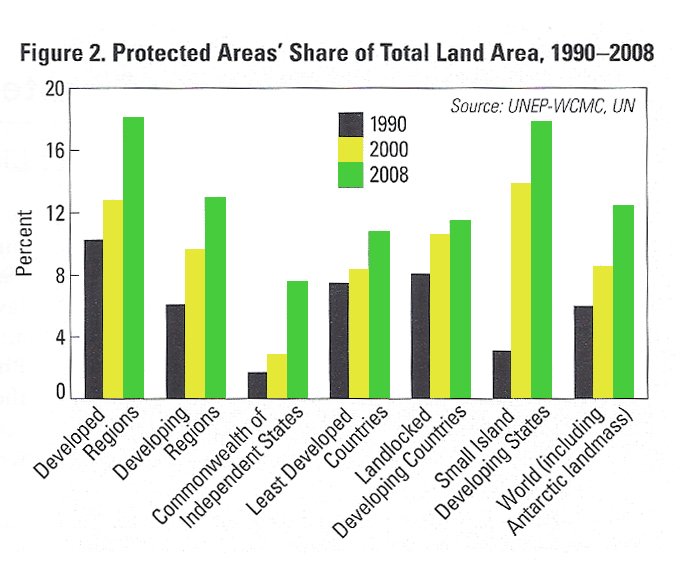
More of the world is protected

Over 12 percent of the world's land area is now officially protected, and that number has been rising fast, doubling just since 1990. You can see it in the right-most bars on the chart below. The rest of the chart breaks down the progress by types of regions.


This reminds me of a story that I can only half remember (by Grant Morrison maybe?), where in the far future humanity, with a population even greater than ours today, has coalesced into a few immense towering city-states, protected by bubbles. The majority of the earth was allowed to return to its natural, wild state, with humanity carefully visiting the "outside" for recreation. It was a peaceful, prosperous future.

Source: Vital Signs 2010, article by Margarita Yatsevich

Sunday, October 9, 2011

Deaf woman hears her voice for the first time

Just a quick feel-good pick-me-up post to tug at the heartstrings and remind us how lucky we all are to live in this day and age. We've come to the point where doctors and scientists perform miracles every day - healing the blind, deaf, and the sick.

This is a woman who has been deaf her whole life. 29 years of relying on reading lips, and to a very limited extent, hearing aids. Here is the video of her receiving a new implant that allows her to fully hear for the first time. Apologies if you've already seen this; it's making the facebook rounds quite a bit:

Friday, September 30, 2011

Getting Better all the time

The recent book Getting Better, by Charles Kenny (from the Center for Global Development, World Bank, and Foreign Policy magazine), is similar to The Secret Peace but focuses on global development. It's a great book, and more succinct than mine, which is an admirable achievement. I heard him speak last night at the UN, and it was enlightening.

One of his main points is that we shouldn't be measuring all progress solely by looking at income and GDP. Income growth has been remarkable in many countries in recent decades. But we've been partially using income as a proxy when we're really concerned about standards of living. There are also plenty of countries that have advanced in many areas recently (literacy rate, education, health, etc) even though their economies are stagnant.

He described the two main reasons for this progress as a decrease in the cost of goods and an increase in demand. The "goods" decreasing in cost are not just commodities and physical goods, but health and education. Likewise, demand has increased for education and health in developing ocuntries as cultural norms change and people come to expect higher standards of living.

I agree, and that's a good way of looking at it, but I think we can still go one layer deeper, to the primary reason for progress: compounding human knowledge. This increase in knowledge is responsible for declining costs: innovations developed for the rich world end up easily spreading elsewhere. The spreading information is also responsible for cultural-norm memes about human rights and what all the world's citizens should expect in their lives (such as the brave participants in the Arab Spring expecting more from their governments.)

After the talk, I asked the question, "Is it important to spread this good news? Conversely, do you ever have doubts or fears of spreading good news about development since a lot of NGO fundraising relies on making events seem as dire as possible?" His answer was great - he says that the current method of "crying crisis" each time money needs to be raised is going to prove less effective soon, since organizations have been doing it for 60 years. People are starting to think that there's no point to donate, since there will always be crises. But by sharing the truth - that our money did help in many cases, and we can see the progress we've made, but there's still more work to be done - it should inspire people to help more and not give in to apathy.

Thanks for the event, Charles!

Check out the book on Amazon.

Nice charts and graphs that illustrate Kenny's points.