- The bad news first: The U.S. is still the country with the highest rate of gun ownership in the world. Second place is Yemen, so that tells you the kind of company we keep. And they have half the rate. However, there is good news:
- In 1973, there were guns in roughly 1 in 2 U.S. households; by 2010 that had dropped to 1 in 3 households.
- In 1980, nearly 1 in 3 Americans owned a gun; by 2010 that had dropped to 1 in 5.
- "One reason that gun ownership is declining, nationwide, might be that high-school shooting clubs and rifle ranges at summer camps are no longer common."

Thursday, April 26, 2012
Happiness is a warm gun - to fewer people
Great article in The New Yorker about America's gun culture, and almost in passing it mentions some superb statistics:


Monday, April 23, 2012
Is bullying a crisis or a myth?
I haven't seen the movie Bully yet, but I've read plenty about it, including this article in last week's The Week. I love the format of The Week, which summarizes all media stories from each week. In this article, it presents opposing viewpoints about the issue.
So, in the first paragraph, it mentions USA Today's claim (and the movie's) that there is a bullying "epidemic" going on. It also describes a Reuters article that agrees with that dire assessment and goes further by describing the terrors of cyber-bullying as well.
The next paragraph describes the counter-point to that claim, from The Wall Street Journal. "This 'bullying crisis' is largely a myth … kids today are 'safer and better-behaved than they were when I was growing up in the 1970s and ’80s.' Adolescent mortality, accidents, sex, and drug use are all down from their levels of a few decades ago. Acceptance of homosexuality is up, and the percentage of students who reported 'being afraid of attack or harm at school' has declined from 12 percent in 1995 to 4 percent in 2009."
The final paragraph provides a counter-point to the counter-point, bringing it back around to the original claim, with high-school student Katy Butler writing in TheDailyBeast.com that she was bullied a lot. She says 43 percent of teens say they've been bullied. Mike Huckabee agrees with her, too.
So, is Bullying a crisis or a myth? Well, why are those the only two options? Can it be neither? It's a real problem, of course, and not a myth. But "crisis" is an overblown term, since it's probably always been a problem and has most likely even gotten better recently. (And Katy Butler's touching testimony is mostly useless as evidence since it is only one anecdote.) I wish there was an easier way for the media to convey, "Hey, this is a problem and we should pay attention to it, but that doesn't necessarily mean the world is ending." Instead we get the default black-or-white views, with no sensible middle ground setting.
It's obvious bullying has always existed. But perhaps the reason we are just noticing bullying as a problem now is that our standards for violence keep changing - what we are willing to tolerate keeps decreasing. This is what Steven Pinker shows in his excellent The Better Angels of Our Nature. Basically, the same amount of bullying in the past would not have been upsetting to us.
PS. In other teen news, rates of teenage pregnancy, births, and abortions in the U.S. have fallen to their lowest level in nearly 40 years. The number of teen girls getting pregnant dropped 42% from its peak in 1990; teen births declined 35% since 1991; and teen abortions declined 59% from their peak in 1988. Also, the percentage of children experiencing unwanted exposure to online pornography declined from 34% in 2005 to 23% in 2010. So, maybe the kids are alright.
Source: The Futurist, May-June 2012.
Saturday, April 7, 2012
Smoothies reveal: Things work better now
My wife Rachel got this smoothie maker as a gift. (Yum!) It's hard to read in my fuzzy phone photo, but the company's name is Back to Basics and their tagline is "Back to Things that Work."

The smoothie machine does work well, but why wouldn't it? Their slogan irks me. I don't know why we tend to think otherwise, but things work much better now than they ever did. There are several reasons for this. One is the increase in government regulations over products. You can argue that this sometimes leads to more expensive products, since extra work needs to be put in to ensure they meet standards, but the result is that products much more often meet the standards. This is really important in cases where safety is an issue.
Another reason things work better now is the whole concept behind the Secret Peace - compounding information. It's in every company's best interest to make their products better, and the longer a certain product has been around, the more it has been improved. And as one company improves a product, its competitors often have to make the same improvements in order to keep up and remain competitive. New features are often introduced at luxury prices before economies of scale and increases in efficiency make them cheaper and they become standard.
Cars are a great example of this. Think how many features cars have now by default that would have been considered luxuries a few decades ago - CD players, automatic locks, air bags, and tons more. Even windshield wipers and seat belts were not a given, if you go back far enough. I don't drive ever since I moved to NYC, so in the rare cases when I get in a car, it seems there's often some new feature I hadn't heard about. Car people probably take these for granted, but I am amazed at the fact that the car seat warms up, for example. That just strikes me as absurdly futuristic. Or even unlocking the doors remotely. Back in my day we used keys - remember those?
Another reason for today's improved products is the ability for the market to make better decisions because of the availability of online reviews. Bad products can't fool us for long, and they all eventually get weeded out. Paul Adams, in his great book Grouped, describes this: "Online, people are overwhelmingly positive about businesses. One reason for this is in the last 50 years, product quality has dramatically increased. Today, most products meet basic manufacturing quality codes, and they work for a long time." (p. 141)
The next time you use any product, think back to if it would have worked better a few years or decades ago. If Windows is giving you a headache, think, "Was my Commodore 64 better?" If plugging your iPod into your car stereo is on the fritz, think, "Was it better when I had a cd player in the trunk?" (Yes, I had this.) And if you have to wait an extra ten minutes at the laundromat because one of the washers is broken, ask yourself, "Would I prefer washing my shirts down in the river?"
Things work better NOW, Back to Basics.
Saturday, March 10, 2012
UN global poverty reduction goal met ... five years early!
A new World Bank report on global poverty is so positive it even surprised me. The key points:

Most of those people who are no longer living in extreme poverty are still very poor by our standards. But we can now see how it's possible to make a difference - we just have to keep up the good work.
Sources: World Bank (pdf), NYTimes, Wikipedia
- Dire poverty continues to fall worldwide. No surprise there.
- But this happened even despite the recent global recession. I had expected the recession might cause at least a small blip in the progress of poverty reduction, but it barely even registered.
- I hope you're aware of the UN's Millennium Development Goals that were set a few years ago, with 8 hugely ambitious global goals in the areas of poverty, health, equality, etc. The world has been making good progress on them, with the deadline being 2015. Well, the goal to cut global extreme poverty in half was just met ... 5 years early.
- This means that the percentage of people living in extreme poverty is now less than half of what it was in the year 1990.
- (Actually, the goal was met in 2008 if you use the original definition of extreme poverty - living on less than $1 a day. That line was adjusted to $1.25 a day; this revised goal that was met in 2010.)
- In 1981, 42% of the developing world lived on less than $1 a day. In 1990, that was down to 31%. By 2008 it was only 14%.
- In 1981, 70% of the developing world lived on less than $2 a day. In 1990, that was down to 65%. By 2008 it was down to 43%.
- The most dramatic progress was made in East Asia. According to the World Bank, "Looking back to the early 1980s, East Asia was the region with the highest incidence of poverty in the world, with 77% living below $1.25 a day in 1981. By 2008 this had fallen to 14%"
- Our ability to get accurate data on all this stuff keeps improving.

Most of those people who are no longer living in extreme poverty are still very poor by our standards. But we can now see how it's possible to make a difference - we just have to keep up the good work.
Sources: World Bank (pdf), NYTimes, Wikipedia
Monday, February 20, 2012
How rich are you?
There's been a lot of talk in the past year about the 1% vs the 99% wealthiest Americans. And while I sympathize with many of Occupy Wall Street's aims (even though when my wife and I walked downtown to see them a few months ago they looked like a bunch of crazy people), it's useful to keep in mind that the wealth divide is very different if we widen our view to the whole world.
That's just what the site GlobalRichList.com has done. It's very simple - you type in your income and it tells you where you fall in the distribution of the whole world's population.
Surprisingly, the income cutoff to be in the world's richest 1% is only $47,500. Doesn't sound too rich, does it? In fact, median household income in the US is about $50,000. Median income per person in the US is about $32,000 - which is still in the top 6% worldwide.
So, the average American is in the 6% wealthiest people worldwide.
Does this mean we shouldn't lobby for a little more income equality in America? No, there are still good reasons to do that. But it does mean we should widen our goals to include the whole world. And perhaps we should remember not to take what we have for granted, and maybe even be willing to part with a little of it to donate to whatever causes we find worthy.
Update: More links:
Household income
Personal income
Americans make up half of the world's richest 1%
Nice blog post by Scott Sumner - The Money Illusion
Similar Washington Post article
Sunday, February 12, 2012
Breaking News! Warning! Everything is OK!

I found this today, forgot I had taken this screenshot a few months ago. It's the home page of the New York Times. Notice the "Breaking News" banner? It's a rare banner they use when something really critical is happening. This one says, "Stocks Remain Volatile on Wall Street, Opening Up More Than 1%."
In my book, when I talk about sensationalism and a loss of perspective in the media, this is a small example of it, right here. And the NY Times is certainly not the worst perpetrator, in fact, they're usually pretty reasonable. But even they can succumb. Is it any wonder that reading the news (and more commonly, watching it) causes stress and anxiety to a lot of people? The whole tone and language and placement of that banner implies something bad is happening. It says, "Stocks remain volatile," which sounds terrible. But in reality, stocks rose, which is generally good news. It's an odd way to position it. And those subtle ways of picking and choosing what gets highlighted, and how it is conveyed, add up over the hundreds of thousands of days we see the news.
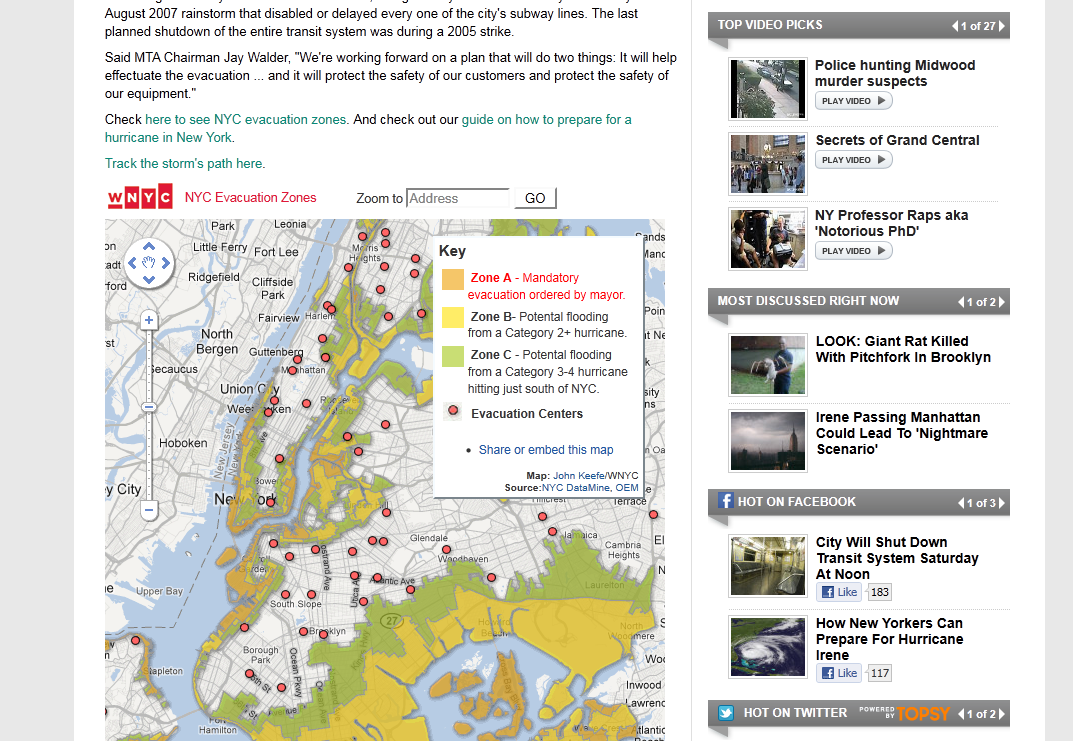
Here's another example, this time from the Huffington Post, which really specializes in sensationalist headlines. It was from around the same time, back when Hurricane Irene battered the East Coast. The headline on a story on the right of the page says, "Irene Passing Manhattan Could Lead to 'Nightmare Scenario.'" Now, Irene was a serious and definitely newsworthy event, and it's good to be prepared, but "nightmare scenario"? It makes it sound like the skies will be raining blood.
These also remind me of the Long Island Railroad, which I had to get used to recently after years of using New Jersey Transit. In NJ, you only hear announcements if there is a delay or something wrong. But not on Long Island. The announcements at the local stations come on a few minutes before the train is due to arrive, and announce in an agonizingly slow and roboticized voice, "ATTENTION ... Long Island passengers ... the 4:29 ... PM ... train ... to Penn Station ... is operating ... ON TIME." Great, thanks for the update. It's almost like it's designed to instill a constant low-level anxiety - for no good reason.
Friday, January 13, 2012
Why the heck is crime so low?
Crime goes up in a recession, right? More people are unemployed, and some of them get desperate. It's only common sense.
Well, think again. Crime rates in the U.S. have been dropping for 20 years, and in the two years since the recession hit, they've dropped even faster. Take a look at this chart, courtesy of this BBC News article:

So why is this happening? The frustrating thing is, no one knows for sure. But there are lots of theories, and I think a combination of the following ones makes the most sense:
- Smarter policing
- More people imprisoned
- Reduction of lead poisoning
- Baby boomers aging (fewer young people)
- Video games
The video games theory is particularly interesting … recent studies have shown that playing violent video games does increase violent tendencies slightly, but this is more than offset by the simple incapacitation of sitting at home playing video games rather than going out to commit crimes. In other words, if video games are increasing aggressiveness at all, players are then taking out that aggressiveness on more video games.
At any rate, no matter what the true cause of the reduction, it's good news. Now if we can just keep that crime rate low without imprisoning quite so large a percentage of our population - strike a slightly smarter balance there, and make sure our prisoners are treated as humanely as possible - it would be the best of both worlds. (For more information about that issue, I recommend When Brute Force Fails by Mark Kleiman.)
And for more details about the crime drop - specifically, homicide, which has just dropped off the list of the top 15 causes of death for the first time since 1965, check out this Washington Post article and this other one, too.
Subscribe to:
Posts (Atom)