Monday, December 31, 2012

More intriguing facts about guns

I did an update in April with some positive gun stats, but in the wake of the Connecticut school shooting, and seeing tons of articles now floating around, I thought I'd revisit the topic. When things like this happen - as they do, on a regular basis - I invariably see several posts or comments from friends that run along the lines of "The world is a terrible place." It's hard to argue with that when a crazy man murders 20 schoolchildren, because it's demonstrably true. However, it's more viable to argue with the similar sentiments of, "The world is getting worse," or "Things are worse than they've ever been," or "What is the world coming to," which I also see commonly. Those ideas are demonstrably untrue. The world may be a terrible place, but there's a lot of evidence that it used to be even worse. Here a chart from Kieran Healy, Associate Professor at Duke:
It shows two clear things: America has a much higher rate of assault deaths than other comparable countries, and that rate has been declining in the past 30 years. This decline mirrors the stats I had listed in my previous blog post, that 1 in 5 Americans now owns a gun (down from 1 in 3 in 1980) and that there are now guns in 1 in 3 households (down from 1 in 2 in 1973.)

Besides that decline, what else is good news? Well, that other countries have learned what we Americans have not yet come to terms with. Specifically, the UK and Australia both had shooting incidents happen, passed stricter laws, and then saw shootings decline. Precipitously.

Noelle Stevenson, an artist I follow on Tumblr, reposted this (it cites many sources, which you can track back from that link):
"'On March 13, 1995, in the small Scottish town of Dunblane, a forty-three-year-old man, Thomas Hamilton walked into a primary school with four handguns and opened fire, methodically killing sixteen children and one adult teacher before killing himself. The unprecedented massacre of children led, within two years, to legislation that imposed a total ban on the private ownership of handguns in the United Kingdom. Today, no one in the United Kingdom can privately own a handgun or a semiautomatic weapon. There was not much hand wringing or heated debate over this legislation. It was discussed, and enacted, with overwhelming public support, in response to the mood of national shame and grief over the killings.' The New Yorker, "Guns and the Limits of Shame" … The U.K. had 14 firearm-related murders last year; the U.S. … had 9,369. In 2008, the U.K. only had 68 gun deaths total … that includes suicide and accident. It was around 30,000 in the U.S." 
Not only do we have overwhelming evidence at the national level that fewer guns leads to fewer deaths (not just gun deaths, but a lower rate overall), we also have that information at the state level. Simply put, states with stricter gun control laws have fewer deaths from gun-related violence. You can see a lot of interesting charts about this in this Washington Post article.

What is the Secret Peace viewpoint on more gun control? It'll happen eventually in this country. I think more gun control makes sense, and it's an area where the U.S. embarrassingly lags behind other developed nations. However, there is a trade-off that we shouldn't ignore, as sacrificing some of our freedoms to have whatever guns we want means also giving up the freedom of the possibility of armed rebellion against a theoretically tyrannical government, which is what the Founders wrote the whole Second Amendment for. But I think at this point the trade-off would be well worth it. A government would have to be extremely tyrannical for a very long number of years to come close to killing as many of its citizens as guns have in the United States.

Saturday, December 22, 2012

Update: World still here

Just a quick update with breaking news: the world did not end yesterday. On April 11, 2010, I posted on this blog that the the Large Hadron Collider did not destroy the world, as some had feared. (Located at this hilarious url: http://thesecretpeace.blogspot.com/2010/04/breaking-news-earth-not-sucked-into.html.) Then I mentioned to expect a similar post in two and a half years when the Mayan Apocalypse failed to materialize. This is that post. What doomsday scenarios will fail to come true next?!?
Update: Here are two great related articles I found: Why some people crave apocalyptic news, at Scientific American, and 6 other apocalypses that never came true, at The Week.

Thursday, November 15, 2012

Assume positive intent

To be happier, what's the smallest, simplest thing an average person could do? That's the question someone asked here on Quora. People responded with a ton of good answers, including getting more sleep, focusing on the positive, shortening your commute, and exercising. But those seem like easy, tangible answers (though no less correct for it.) On the other hand, Jeff Shattuck's answer struck me as ideologically insightful, even revolutionary. He advocates "assuming positive intent."

Life's daily mishaps are easier to swallow if you assume that every offense, insult, and slight by the people you interact with is unintentional. In other words, don't take things personally. In the vast majority of cases, that person was simply trying to go about their day and take actions to make life a little more palatable for them and their loved ones. If they could have achieved the same goals without offending you, they most likely would have. There was no malice involved.

On a societal level, this goes along with what Steven Pinker has said in The Better Angels of Our Nature about the place of "honor" in societies. Honor sounds like a noble trait, until you realize that the societies that value honor above all are those in which citizens react in kind to every slight, and thus remain stuck in cycles of violence. Only by forgiving and forgetting are we able to reach peace.

Thursday, September 27, 2012

Post #100 - all about babies!

So, my wife and I are expecting a baby! And I was showing my parents our sonogram the other day:
… when my mother mentioned that when she was pregnant with me, she didn't have a sonogram. So there are officially no pre-birth pictures of me. For some reason, this totally surprised me. Having never actively thought about sonograms before, and because they are so strongly associated with pregnancy in TV and movies, I think I subconsciously thought they always existed. Or at least, that they were invented in the 1920s or something. (I think I was confusing them with X-rays.) Turns out, as you can read here and here, medical sonography was invented in the late 1940s but was not used for pregnancies until the 1970s. Now, it's so common and easy that my wife and I already have 16 pictures of our baby on the fridge, and she's only just started her second trimester. We already have almost as many photos of my child before its birth than I have of the first few years of my life or my father has of practically his entire childhood.

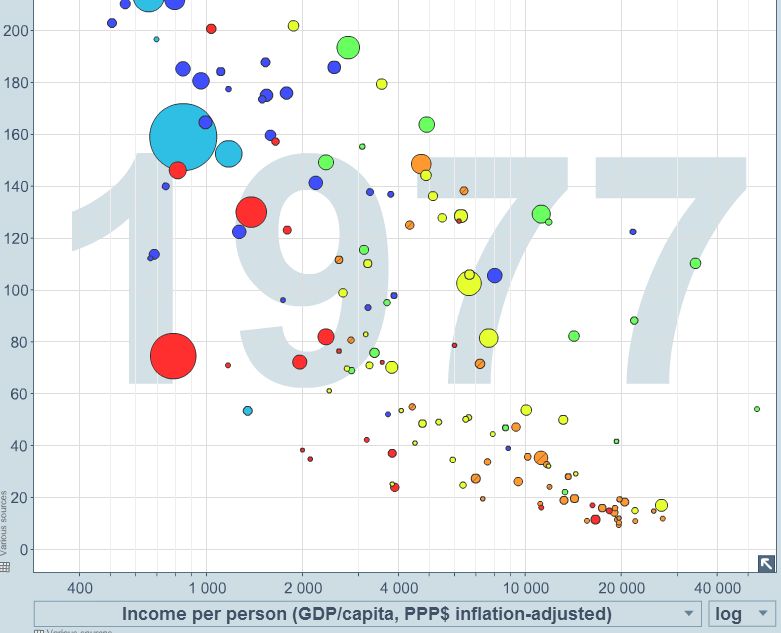
This is just one of the many advances that adds up to the lowest infant mortality rate in history. Take a look at this chart from The Secret Peace:
The scale on the left is infants per 1,000. So if we look at 1977 (the year I was born), we see an infant mortality rate of about 20 per 1,000 (or 2 percent) in developed countries. Today, that's down to less than 10 (1 percent). The drop in developing countries happened at a similar rate: from about 95 to almost 50 (9.5 percent down to 5 percent). Obviously there is still a huge gap between developed and developing countries, but you can see where the trend is quickly headed.

In the couple years since I did the above research and published the book, more data resources are available online. Here's an article about a specific case study on Niger, which reduced its child mortality (which means children under 5 years, slightly different than infant mortality) nearly in half from 226 (22.6 percent) in 1998 to 128 (12.8 percent) in 2009. And the ever-excellent Gapminder shows this chart, which, if you hit "Play" on the bottom, lets you see the trend from 1950 to today for every single country at once! You can watch all the countries drop over time towards a better rate (and increase in wealth, which is also shown on the chart). In the earlier years, many of the countries have such a high rate that they are literally off the chart.


By the way, here are two opposite points of reference: the lowest rate in the world today is Iceland, which loses only three infants per 1,000. That's .3 percent. On the other hand, for most of human history until about the 19th century, the entire world had an infant mortality rate of around 250 per 1,000. This means one out of every four babies died in their first year. Since my wife and I are experiencing a pregnancy firsthand now, I can start to fathom what a horrible tragedy that must have been for everyone - nearly all parents lost children - as well as what a colossal drain of resources and human endeavor.

At first glance, our great success in decreasing infant mortality would seem to have a terrible side effect: too many people. We've all heard about the threat of overpopulation and what a drain we all are on the earth's resources. Luckily - surprisingly - fertility rates have been decreasing simultaneously.
This chart is from this cool page of infographics. The decrease in fertility rates is happening for many reasons, but one is a consequence of the decrease in infant mortality: the logic that if your child is more likely to survive and thrive, you don't need to have as many to get the same result (a child surviving to adulthood.) 

So, all in all, it's a good time to be a baby. And personally, we can't wait to introduce our upcoming little one to a world that while very imperfect, continues inexorably to improve.

Sunday, September 16, 2012

Are Americans reading more now than ever?

From the Atlantic … the next time someone says the Internet killed reading books, show them this chart:


The chart has a number of problems, not the least of which is how they put the present time on the left, defying all normal chart conventions, and therefore making it look like there was a decline. Sigh. But other issues include the gap between 1957 and 1990, and that there is no more recent data than 2005. So I went looking for more.

This article presents a nice summary of the Pew Research Center's recent research into U.S. adult reading. It shows that 78 percent of adults read a book in the past year, and that four times the number of people are reading e-books compared to just two years ago. It looks like the larger the number of book formats available - e-books, audio books, print - the more reading.

And the Mary Sue reports that Generation Y (those born between 1979 and 1989) has just officially overtaken the Baby Boomers as the generation that reads the most books (and 43 percent of their book purchases are online).

I found a lot more statistics online that seem to be all over the map. The ones bemoaning our assumed decline in reading are often presented with no context, so it's only really the stats that compare over a long time that are valuable.

As a side note, here's a tidbit from The Week (Aug 24-31, 2012): "A textual analysis of 1.2 million books published since 1900 found that the proportion of male pronouns to female pronouns fell from 4.5 to 1 in the 1950s to less than 2 to 1 in 2005." If I had to make a guess, I would bet that the number of female authors rose dramatically in the same period. This relates back to the overall reading numbers, of course, in that a surefire way to make reading appeal to greater numbers of people is to increase the diversity of what's available.

PS> Keep an eye out for my next post - a special announcement just in time for my 100th blog post!

Monday, August 27, 2012

This one health product will change your life forever!

I don't think I've ever directly hawked a product on this blog before (other than maybe some recommendation asides), but this is important. You will not believe how much healthier this product will make you. My wife and I both tried it, and we can look forward to a much healthier life than if we had never used it. And as soon as we had finished our treatment, I immediately lent it to my parents to give it a try, and then I'll loan it to my friends.

This product works directly on the brain, by clearing out toxins caused by today's fast-paced environment. You wouldn't believe how many of these toxins we've all accumulated over our lifetimes - without even knowing it! These toxins include misconceptions, rumors, bad advice, snake oil, old wives' tales, and superstitions. And this product will clear them all away.

That's because it's an educational course, on DVD. (There's an audio version, too - and you can stream them both online as well.) It's one of the Great Courses, a series of lectures by esteemed professors on tons of topics. I've been watching them for years, and I can honestly say this is the best one I've ever seen. My wife and I watched all 24 episodes together, riveted. The content was great, and the presenter, Dr. Steven Novella of the Yale School of Medicine, was excellent.

Debunking myths is a long-time hobby of mine, but the majority of this information was new to me. Unless you're a doctor - and one well-versed in every specialty, who stays up-to-date on recent studies and the scientific consensus - I bet most of it will be new to you, too. Did you know …
  • Vitamin C does not help colds. (Try to find a bottle that says it does!) 
  • You don't have to wait after eating before swimming. 
  • Homeopathy is a complete myth. 
  • "Natural" is not inherently better than man-made … in fact, it's often worse. 
  • Hypnosis is real, but doesn't work the way you'd expect. 
  • Amnesia is real, but people never forget their identities. 
  • Acupuncture is fake, but still beneficial. 
  • Sugar does not lead to hyperactivity. 
  • And what about probiotics? Antioxidants? Toxins? and, and ...

The myths range from harmless to dire. Taking extra vitamin C will not hurt you, for example. But certain of the myths in this series are responsible for the deaths of thousands of people - such as the myth that vaccines cause autism, or the myth that sleeping with a virgin can cure HIV (yes, this is a real belief in some parts of Africa.)

More important than any specific myth is the framework that Dr. Novella shares in how the medical industry works, how doctors think, and how to judge medical claims for yourself. How are drugs evaluated? Are placebos ethical? How does misinformation spread? Does the way we think about specific "diseases" even make sense in many cases? And in general, how should we safeguard our own health - and the health of our children and others we care about - when we swim in such a vast sea of competing medical information?

Watch the DVD and find out. If you've read The Secret Peace, you know that in today's day and age, we each finally have the means and the responsibility to investigate truths for ourselves. This has tremendous potential benefit, but it can also be a burden. This course is a huge help. I wish they had taught this in school; I think it should be essential viewing for everyone.

Monday, August 13, 2012

Goodbye, Capital Punishment

Did you hear that Connecticut abolished the death penalty? The state's practically next door, but somehow I missed this news when it happened in April, and just found it now. What's interesting is how it's part of a trend: Connecticut is the 17th state to abolish capital punishment (along with the District of Columbia, too), and the fifth in just five years.

When it comes to the death penalty, I believe the trends show: 1) the gradual abolishment of capital punishment in the world, 2) a glimpse - probably in our lifetimes - of a world in which the concept itself will feel outdated and barbaric, and 3) that this is part of a larger trend of decreasing violence. Capital punishment, even when carried out by a legitimate state with the support of its citizens, is still violence of a type. And as Gandhi taught, violence - though it can accomplish short-term goals - inevitably sows long-term problems (usually more violence.)

The decline of the death penalty in the U.S. can be tracked not just by the number of states endorsing it, but by two other trends. This chart shows one:


This is from Steven Pinker's Better Angels of Our Nature, and shows the rate of executions declining dramatically. That's right, even in the states that still have it on the books, it's mostly used less frequently.

In addition, Pinker brings up a good reason to abolish it: because it's a slippery slope. With execution on the books it's simply too easy to put innocent people to death. Did you know that during the last years of the reign of Henry VIII, there were over 10 executions in London per week? By 1822 England had 222 capital offenses on the books, including cutting down a tree. But by 1861 this had been reduced to four. The Wikipedia page on capital punishment in the U.S. has an interesting chart showing when the last execution was for each crime other than homicide. The last execution for witchcraft, for example, was in 1779, and the last for burglary was in 1941.

In fact, it's estimated that in the past 2,000 years, 19 million people were executed worldwide for trivial offenses. I had this same thought while reading Game of Thrones recently, as the capricious king in the book executes practically everyone who so much as glances at him funny. We take for granted the simple concept today - even if we support capital punishment - that the death penalty should be used only for dire offences, and only after a lengthy evaluation of guilt. Soon, there will be no offences left that we deem worth it.