I want to take a break from laughing at Secret-Peace-related memes because this headline caught my eye:
"The U.S. ranks 26th for life expectancy, right behind Slovenia"
It's on Wonkblog, which I like, but the headline itself and overall slant of the article is a good example of why I wrote The Secret Peace. Part of the problem of why the media seems so negative is that even an article like this one, which is pretty even-handed if you read the whole thing, is positioned at the top to be as sensational as possible.
The whole implication of the headline and beginning of this article is how far the US has fallen. In fact, it even states it that way: "Back in the 1970s, Americans typically lived longer than residents of other countries. Not anymore: A new report ... shows that the United States' average lifespan has fallen one year behind the international average."
If you were to skim that sentence, or even diagram it, you might grasp some variation of "The average US lifespan has fallen."
This, of course, is not true. And the article goes on to say so: in fact, US life expectancy is eight years longer now than in 1970. So what accounts for the relative "decline"? It's just that other countries are doing even better. This is not a bad thing. The US does have the largest population on the list, far larger than most of the 25 top countries, which makes it pretty impressive that we're as far up as we are, honestly. #26 still puts us almost in the top 10% of countries in the world. Who cares if we're #1, as long as things are headed in a positive direction?
I understand the reason for the article's positioning. The US does indeed rank surprisingly low on several health indicators, if you expect us to be first. (But why do we expect that?) And, as a US publication aimed at a US audience, US updates are the most pertinent information. They "sell" much better than an article geared around "Hooray, Slovenia! Through decades of hard work, you have ever-so-slightly surpassed the US in life expectancy."
The real news for the US is not how well or poorly we're doing in life expectancy - because we're right in the middle of the world's developed countries, a perfectly reasonable place for us to be - but how poorly we're doing in comparison to how much we spend. Again, the article makes this point, but it's a case of burying the lede. It's a shame that for every person who reads that far, another 50 will have seen this headline in their Facebook or Twitter feed, and get a skewed perception of the situation.

Thursday, May 8, 2014


Tuesday, April 1, 2014
Funny post #4: Canada
In a weird corner of the memeworld of the internet, there's a whole storyline making fun of Canada for being ... a great country. You rarely see memes attacking a country or poking fun at a country for any reason (although occasionally Americans do come under fire, and Vladimir Putin and Kim Jong-un are both popular targets), so it's weird that the most common country meme is about how good a country is. Take a look at some of these.


 This one mentions how Canada reveres scientists:
 One of the recurring themes is about how great Canada's free health care and other social services are:

 And this one introduces us to a theme we'll examine next time:
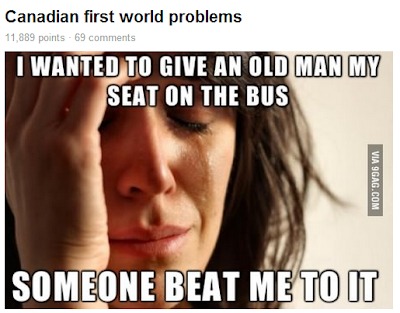 What's ironic is that these "nice" qualities are not rare in developed countries. Universal health care, for example, is found in about 60 countries. But like many self-reinforcing stereotypes, people remember the hits and ignore whatever doesn't fit the pattern. It's just a nice change of pace that in this case the stereotype is a positive one.


Saturday, March 22, 2014
Funny post #3: Phones
Last blog post, we looked at the funny meme of advanced computer technology - basically being awed at how lame computers were in the past and how far we've come. Stuff like this:
 Here's a fascinating subset of that: phones. Mobile phones are perhaps the easiest way to see technological progress. We're reminded of it any time we use our phone, so about a million times a day. It's nice to step back every once in awhile and appreciate how far we've come:


Tuesday, February 4, 2014
Funny post #2: Our wondrous technology
Isn't technology great? In this second of a series of posts looking at how humor today echoes Secret Peace themes, we'll look at some technology jokes. Technology is one of the easiest ways to see progress happening, and in the past few decades, "technology" has often been synonymous with computers. An easily tracked sign of progress is Moore's Law: that transistor capability doubles every two years. So I found this online:

That post is just sort of a "wow" or feel-good post, but a funnier theme is to post about how amazed people were with computers in the past, even though from our perspective, they were awful.


Or how about this post, meant as a quick gag and "apple" pun, but really a profound comparison of life today with less than a century ago:

Or how about the advances in access to information? My generation was the last to make it through school without Google. (I graduated college in 1999.) My daughter will grow up never experiencing the simple burden of not knowing something - even topics in which final knowledge still eludes us have easy access to speculation and what we know so far.

Of course, we often forget that technology doesn't just refer to computers. Look at the all of the advances in health, such as prosthetic limbs.

Or look at this GIF comparing car safety from 1959 with 2009:

Of course, with all new technology comes fear of change, some wise and some unfounded. This XKCD cartoon helps keep it in perspective:

Monday, January 6, 2014
Funny post #1: Making fun of the past
I've been collecting any funny cartoons, jokes, or memes I've found online that pertain to the message of the Secret Peace, that is, progress. I'm going to present them over the next few blog posts.
I could just present them by themselves, since they are meant to be interpreted on their own, and some of them are pretty funny. But as you read them, I think there's a larger point to keep in mind, one that makes me happy. I think that popular humor reflects our culture, and since online humor often reflects younger people than the culture at large (and many of these memes are from 9gag, which is populated by a lot of younger users), it is a good signifier of where the culture is going. I've been seeing more of these types of jokes recently, and I'll take that as a good sign that not only are the few people creating them in line with Secret Peace themes, but so is the larger audience, since the ones I've found are the ones getting passed around social media or voted up on the humor sites.
The theme of today's jokes is making fun of the past. Let's start with an opposite joke, to prove a point. This is the only joke I've come across that I've seen as directly in opposition to The Secret Peace - and thus, from my point of view, terribly incorrect.
 Ugh, this is awful. Are people really envious of these folks shooting arrows in the woods? And while I guess it's true that they have "no bombs", saying that there is "no poverty" in pre-industrial hunter-gatherer cultures is a gross inaccuracy. They don't even have clothes. They are 100% the embodiment of poverty; this is what economists define as "extreme poverty" (actually, it's probably even beyond that). And I'm sure there's "no stress" in having to hunt for your food every day. I'd like to see the person who posted this try it. I'm sure it's much less stressful than your day creating memes on 9gag.
Here's a better cartoon, by New Yorker artist Alex Gregory, that kicks holes in the logic of that previous item.

And here are some more. Some are quick gags, or interesting factoids, and others are more thought-provoking. They all make the basic point of: "Hey, don't romanticize the past. Compared to back then, today's not that bad."


And here's one final one to help you feel better on this "Blue Monday" (which allegedly is the most depressing day of the year, but in reality is made up). Stay tuned to the next few posts for more funny, progressive stuff.

I could just present them by themselves, since they are meant to be interpreted on their own, and some of them are pretty funny. But as you read them, I think there's a larger point to keep in mind, one that makes me happy. I think that popular humor reflects our culture, and since online humor often reflects younger people than the culture at large (and many of these memes are from 9gag, which is populated by a lot of younger users), it is a good signifier of where the culture is going. I've been seeing more of these types of jokes recently, and I'll take that as a good sign that not only are the few people creating them in line with Secret Peace themes, but so is the larger audience, since the ones I've found are the ones getting passed around social media or voted up on the humor sites.
The theme of today's jokes is making fun of the past. Let's start with an opposite joke, to prove a point. This is the only joke I've come across that I've seen as directly in opposition to The Secret Peace - and thus, from my point of view, terribly incorrect.
Here's a better cartoon, by New Yorker artist Alex Gregory, that kicks holes in the logic of that previous item.
And here are some more. Some are quick gags, or interesting factoids, and others are more thought-provoking. They all make the basic point of: "Hey, don't romanticize the past. Compared to back then, today's not that bad."
Monday, November 25, 2013
Rewriting an important message to girls
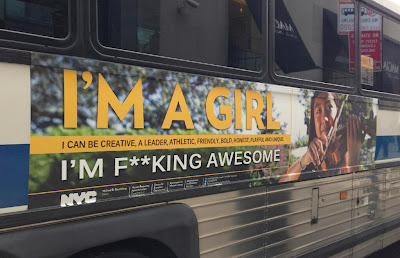
If you live in New York City, perhaps you've seen this new public service ad campaign over the last few weeks. It's meant to help with young girls' self-esteem:

I know I'm not the target audience, but I am now the father of a young girl, and I was immediately turned off by these ads. At the same time, I was disappointed in my harsh reaction, since it was obvious that the many people behind these ads clearly had their heart in the right place. So I'm going to try to not be too mean here. But there are some problems.
1) Let's start with a nitpick. There's a pretty well-rounded list of adjectives in the ad, but it includes "sporty". Well, turns out there's already a word for "sporty", and it's called "athletic." Sporty is just a girlier word for athletic. We don't need dumbed-down female versions of words - I would think that's just the sort of thing this ad campaign should be fighting against. It might as well say, "I'm sporty, posh, ginger, baby, and scary." Granted, that would convey girl power, but I'd rather just change it to athletic:
2) Here's another small issue. That same sentence says "I'm creative, a leader, athletic, friendly, bold, honest, playful and unique." That's a tall order, a lot of pressure. It almost sounds like a girl HAS to be ALL those things. Instead, the message should be that she can be anything she likes. She doesn't HAVE to be athletic, and not everyone is a leader. She can be some of those things, or even none. She has the capability to be anything she wants. How about:
3) Here's a much more important issue, indeed the first one that jumped out at me: the use of the word "beautiful". As the final adjective, it's implying that it's the most important one. And if there's one thing we really want to convey to girls, it's that BEAUTY IS THE MOST IMPORTANT THING. Why in the world did they go in this direction? You could argue that they are using the word "beautiful" not in the exterior "looks" sense but in the "inner beauty" sense. But there are better words for that: "I'm proud of the way I am", "I'm awesome the way I am", "I'm great the way I am", etc. "Inner beauty" is a subtle connotation that is not the first thing you think of when you see the word "beautiful". (If it was, we wouldn't ever need the prefix-word "inner".) They should have avoided it altogether:
4) Lastly, let's look at the rest of that closing sentence. "I'm beautiful the way I am." What a let-down. Maybe it's just me, but here's what that sounds like: "I'm ok even though I'm not a boy." or "Hey, I was born a girl, but I'm dealing with it." or "I may not have a penis, but I'm almost as good." WTF? It seems so meek and defeatist. Why not go with a more uplifting ending? How about just:
Straightforward and to the point. It should be inspiring. I would be proud for my daughter to see this ad now.
You may argue that I'm nitpicking and wordsmithing this too much. But that's the whole point of feminist critique: that there are subtle biases even in our language that convey that women are not equal to men. I'm really surprised that nobody who helped with this ad thought this way; it's the whole reason for the ad, after all. I've worked at several ad agencies, and trust me, all ads are edited this much. You only have a few words to work with (they used 20), and a few seconds of the audience's time, so you have to make each word count.
Which brings me to my final edit ... something to really make the ad "pop" and grab people's attention. I realized, hey, this ad is for NEW YORK CITY. What says not just "I'm an awesome girl" but "I'm an awesome New Yorker"? How about:
PS. For a better example of empowerment, check out this awesome GoldieBlox ad.
I'm a girl
I'm creative, a leader, sporty, friendly, bold, honest, playful and unique.
I'm beautiful the way I am

I know I'm not the target audience, but I am now the father of a young girl, and I was immediately turned off by these ads. At the same time, I was disappointed in my harsh reaction, since it was obvious that the many people behind these ads clearly had their heart in the right place. So I'm going to try to not be too mean here. But there are some problems.
1) Let's start with a nitpick. There's a pretty well-rounded list of adjectives in the ad, but it includes "sporty". Well, turns out there's already a word for "sporty", and it's called "athletic." Sporty is just a girlier word for athletic. We don't need dumbed-down female versions of words - I would think that's just the sort of thing this ad campaign should be fighting against. It might as well say, "I'm sporty, posh, ginger, baby, and scary." Granted, that would convey girl power, but I'd rather just change it to athletic:
I'm a girl
I'm creative, a leader, athletic, friendly, bold, honest, playful and unique.
I'm beautiful the way I am
2) Here's another small issue. That same sentence says "I'm creative, a leader, athletic, friendly, bold, honest, playful and unique." That's a tall order, a lot of pressure. It almost sounds like a girl HAS to be ALL those things. Instead, the message should be that she can be anything she likes. She doesn't HAVE to be athletic, and not everyone is a leader. She can be some of those things, or even none. She has the capability to be anything she wants. How about:
I'm a girl
I can be creative, a leader, athletic, friendly, bold, honest, playful and unique.
I'm beautiful the way I am
3) Here's a much more important issue, indeed the first one that jumped out at me: the use of the word "beautiful". As the final adjective, it's implying that it's the most important one. And if there's one thing we really want to convey to girls, it's that BEAUTY IS THE MOST IMPORTANT THING. Why in the world did they go in this direction? You could argue that they are using the word "beautiful" not in the exterior "looks" sense but in the "inner beauty" sense. But there are better words for that: "I'm proud of the way I am", "I'm awesome the way I am", "I'm great the way I am", etc. "Inner beauty" is a subtle connotation that is not the first thing you think of when you see the word "beautiful". (If it was, we wouldn't ever need the prefix-word "inner".) They should have avoided it altogether:
I'm a girl
I can be creative, a leader, athletic, friendly, bold, honest, playful and unique.
I'm awesome the way I am
4) Lastly, let's look at the rest of that closing sentence. "I'm beautiful the way I am." What a let-down. Maybe it's just me, but here's what that sounds like: "I'm ok even though I'm not a boy." or "Hey, I was born a girl, but I'm dealing with it." or "I may not have a penis, but I'm almost as good." WTF? It seems so meek and defeatist. Why not go with a more uplifting ending? How about just:
I'm a girl
I can be creative, a leader, athletic, friendly, bold, honest, playful and unique.
I'm awesome!
Straightforward and to the point. It should be inspiring. I would be proud for my daughter to see this ad now.
You may argue that I'm nitpicking and wordsmithing this too much. But that's the whole point of feminist critique: that there are subtle biases even in our language that convey that women are not equal to men. I'm really surprised that nobody who helped with this ad thought this way; it's the whole reason for the ad, after all. I've worked at several ad agencies, and trust me, all ads are edited this much. You only have a few words to work with (they used 20), and a few seconds of the audience's time, so you have to make each word count.
Which brings me to my final edit ... something to really make the ad "pop" and grab people's attention. I realized, hey, this ad is for NEW YORK CITY. What says not just "I'm an awesome girl" but "I'm an awesome New Yorker"? How about:

PS. For a better example of empowerment, check out this awesome GoldieBlox ad.
Monday, November 18, 2013
Update on interracial marriage
The interracial marriage of Bill de Blasio, newly elected mayor of New York, is generating a lot of headlines. De Blasio may be the first white politician in U.S. history elected to a major office with a black spouse. Not only did this not ruffle the feathers of very many New Yorkers - probably the most diverse city on the planet, after all - but it looks like it probably helped get him elected.
I've got a chart in the Secret Peace book reflecting the trend of acceptance of interracial relationships:
 A clear trend, but I only had data at the time up to the year 2000. However, the trend is so obvious that we can pretty safely extrapolate what it would look like if it continued to today (in blue):
 Pretty impressive, as the two groups' opinions are converging around the 80-85% mark. But what's really interesting is that one of the articles about de Blasio, in the Huffington Post, mentions current trends - allowing us to update the chart for real:
 The result (in red) is even higher than projected. The percentage of whites approving went from 4% in 1958 to 86% now. Today, across America, only 14% of whites disapprove of mixed marriage, and an amazingly low 2% of blacks disapprove.
Can you imagine this trend ever reversing? I can't. Nearly everyone approves of interracial marriage, something that would have been inconceivable to folks a few generations ago. Though they're going at different speeds, all other trends of tolerance are moving in the same inevitable direction as well.
I've got a chart in the Secret Peace book reflecting the trend of acceptance of interracial relationships:


Can you imagine this trend ever reversing? I can't. Nearly everyone approves of interracial marriage, something that would have been inconceivable to folks a few generations ago. Though they're going at different speeds, all other trends of tolerance are moving in the same inevitable direction as well.
Subscribe to:
Posts (Atom)